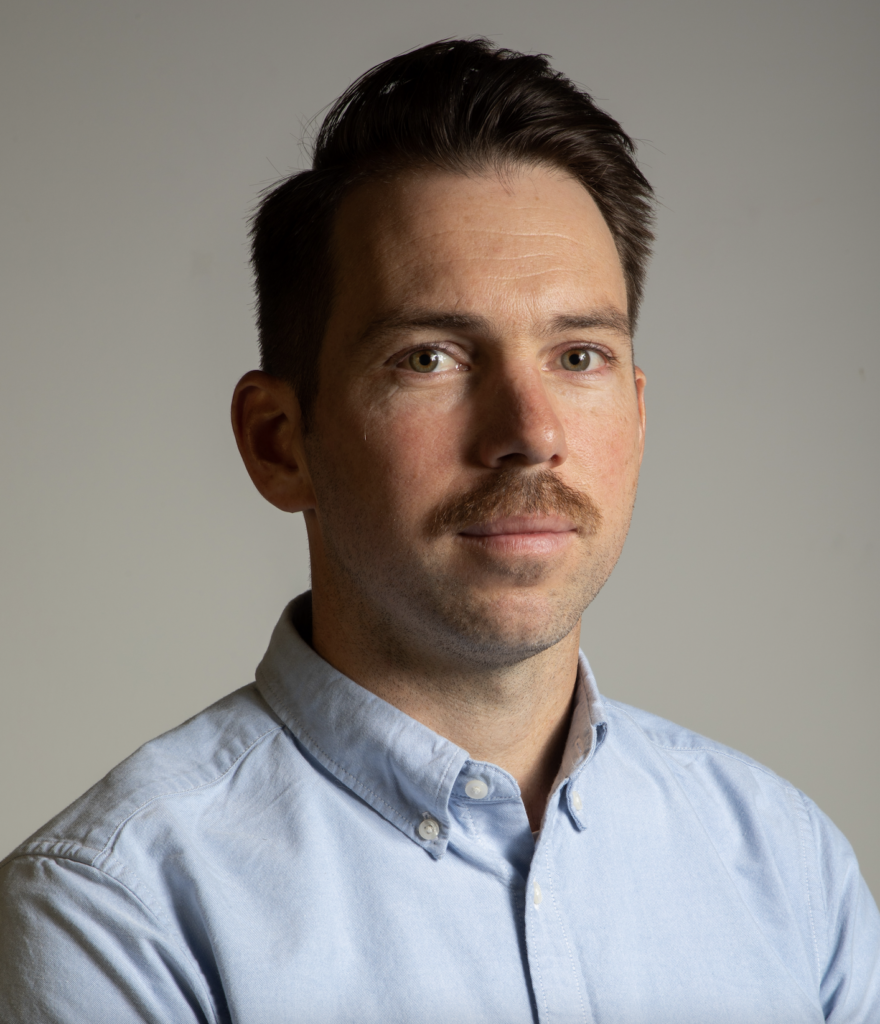
Dr. Matthew I. Thompson is interested in exploring how media influence our assumptions about nonhuman nature. As an assistant professor in the Film Department, Matthew teaches courses like “The Art of Motion Pictures,” “Ecological Film and Media,” and “Food on Film.” Before coming to Regina, Matthew was a sessional assistant professor at York University, where he taught in the Cinema and Media Arts program. He earned his PhD from the Cinema Studies Institute at the University of Toronto.
Matthew’s book, On Life Support: Eco-Dystopian Cinema in the Long 1970s (University of Minnesota Press, 2026), investigates how the environmental politics of the 1960s found themselves expressed in the dystopian science fiction films of the following decade. On Life Support argues that films like Silent Running and Soylent Green, which turned the doomsday rhetoric of environmentalists into hypothetical futures, demonstrate many of the problematic assumptions that underlie ecological rhetoric. Other areas of interest include Indigenous futurism, critical animal studies, artificial intelligence, and film philosophy. Matthew has published in the journals Spectator, World Picture, and The New Review of Film and Television Studies.
Machines Gone Wild: Ecological Robots in Science Fiction Media The 1972 eco-science fiction film Silent Running concludes with a shot of a space greenhouse drifting into the void, a little floating ecosystem entrusted to the care of a small, artificially intelligent robot. This robot has been trained by an astronaut named Freeman Lowell (Bruce Dern), who destroys his own ship shortly after jettisoning the robot and its garden into space. The implication is that, free from human hands, the environment and its robotic gardener can exist in harmony into eternity. This fantasy of an AI-controlled environment crops up in other films as well: WALL-E (2008) and The Wild Robot (2024) being two prominent examples. In my proposed project I will investigate the fantasy that without human involvement, technology and nature would thrive in a symbiotic relationship. Why do we imagine AI as more capable environmental stewards than ourselves? What does the desire to offload environmental responsibility onto AI reveal about our ecological assumptions, politics, and fears? How do cinematic representations of artificially intelligent environmental robots help us to understand our own complicated relationship to ecological responsibility?
Profile: Dr. Matthew I. Thompson was last modified: June 19th, 2026 by HRI_admin